
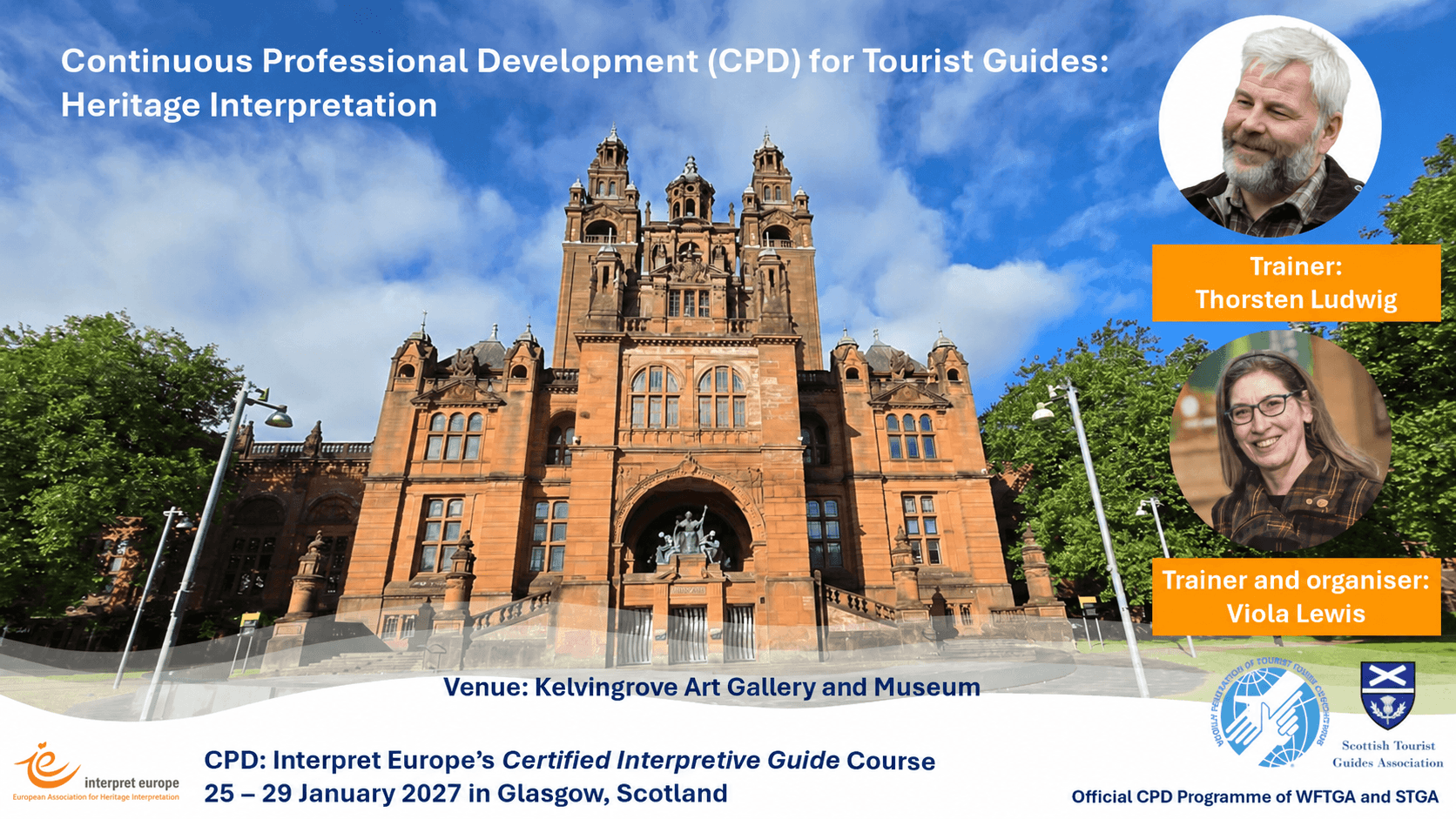
NEW Date: 25 to 29 January 2027
Once again, the World Federation of Tourist Guide Associations (WFTGA) is delighted to bring Interpret Europe’s Certified Interpretive Guide (CIG) Course to the WFTGA Family as part of the 2026 pop-up CPD Programme. This time the course is hosted by long-standing WFTGA Member the Scottish Tourist Guide Association in Glasgow, Scotland and forms part of the official STGA CPD Programme.
The course: This hands-on, immersive training programme is designed to elevate tourist guides’ heritage interpretation skills to better meet ever evolving guests’ expectations, while demonstrating a strong commitment to protecting our shared cultural and natural heritage.
Across five days (40 hours), we will explore creative, imaginative techniques that arouse curiosity, spark emotions, and help guests form meaningful connections with heritage. Together, we will uncover the stories and secrets of everyday life that make places memorable and worth safeguarding.
This course is ideal for tourist guides wishing to take stock after an intense guiding season, re‑discover the creative joy of interpretation, and engage in thoughtful discussion about current trends in heritage protection, sustainability, and innovative visitor engagement.
The Venue: Kelvingrove Art Gallery and Museum
This world-class, wonderfully diverse venue is one of Glasgow’s most iconic cultural spaces, celebrated for its striking architecture and its exceptional, wide‑ranging collections. With 22 galleries showcasing everything from European fine art to natural history, from archaeology to Charles Rennie Mackintosh’s Glasgow Style, Kelvingrove offers an extraordinary breadth of stories, objects and ideas under one roof. Its mix of world‑class masterpieces, everyday artefacts and global cultural treasures makes Kelvingrove a vibrant setting for exploring how people, places and histories connect. The museum’s welcoming atmosphere and rich diversity of collections provide an inspiring backdrop for creative learning, reflection and discovery. Importantly, Kelvingrove shows courage in asking questions about current issues such as how museums represent diverse communities, how colonial histories are addressed and contextualised, how natural heritage is communicated in an age of climate change, and how everyday objects can reveal powerful social stories.
Course Fee: 1,000 EUR (without accommodation)
The Trainers:
Thorsten Ludwig (acclaimed and experienced IE Trainer) and
Viola Lewis (WFTGA LIT and newly qualified IE Trainer)
Download the course brochure here
For further information contact the course organiser at viola@wftga.org
From 950,00 €
Thorsten Ludwig
MSC Interpretation: Management and Practice (UHI, UK) / Self-employed with Bildungswerk interpretation since 1993 / Managing Director of Interpret Europe from 2015-2021 / Ran more than 30 Interpret Europe training courses in nine countries / Trainer/co-trainer of all Interpret Europe Certified Interpretive Trainers (CIT).
Our courses help parks, monuments and museums to make a difference to the development of society. It gives me goosebumps every time I see our participants discover the power of meaning, the magic of interpretive skills, and their own responsibility in enabling others to interpret heritage in an appropriate way.
Viola Lewis
Blue Badge Tourist Guide for Scotland, T-Guide (Guiding People with Learning Difficulties), Trainer with the Scottish Tourist Guides Association (STGA), Trainer with the European Federation of Tourist Guide Associations (FEG), Lead International Trainer with the World Federation of Tourist Guide Associations (WFTGA)
I love working with people from different backgrounds and guiding our shared learning journeys; helping tourist guides discover their own style, authenticity and pride in celebrating their unique heritage — while elevating their skills to global standards. My dream is to help bring tourist guides more fully into the heritage interpretation community and strengthen our global voice. I believe a trainer’s true role is to train themselves out of a job: to be a springboard, and a source of encouragement for the next generation of heritage interpreters to carry our work forward into a more sustainable and peaceful world.
Of particular interest and granted priority access to contribute to interpretive content development to:
Language:
The Course will be delivered in English. Practical assessments and written examinations will be conducted in English. Therefore, participants require a working knowledge of English, both written and spoken.
Set in real heritage contexts, it equips participants to design, deliver and encourage meaningful, engaging interpretation for diverse groups of people and settings.
Personal interpretation – connecting places, objects and stories to people’s lives; using themes and universal concepts to create relevance and resonance.
Communication skills – structuring commentary, voice and body language, questioning and listening techniques, managing time and space, and ensuring clarity and accessibility.
Meaning-making – moving beyond facts to reveal relationships, ideas and values; crafting strong themes and purposeful narratives that provoke curiosity and reflection.
Interactive tools for working with tourist groups – activity-based techniques, sensory prompts, use of objects and props, mapping and simple games to energise and involve participants.
Facilitation skills – enabling dialogue, handling group dynamics, encouraging participation, managing expectations and emotions, and guiding respectful, value-based exchanges.
While the course includes concise input sessions, most learning is hands-on and reflective. Methods include:
Indoor and field exercises that translate concepts into practice
Exercises in museum exhibitions, working directly with tangible and intangible heritage
Structured discussions to deepen understanding and share perspectives
Simulations and presentations to rehearse real guiding scenarios
Feedback from trainers and peers to refine delivery and sharpen messages
Short lectures to anchor practice in proven interpretive principles
Day 1 – Foundations of Interpretation
What is heritage interpretation and how do we help people find meaning?
Core concepts, ethics and standards; practising essential interpretive skills
Day 2 – Interpretive Talks
Experiencing, developing, conducting and evaluating interpretive talks
Crafting clear themes, structuring content, engaging openings and memorable closes
Day 3 – Interpretive Walks
Creating and embedding (memorising) interpretive walks and storylines
Conducting walks; peer review focused on clarity, flow and audience engagement
Day 4 – Roving Encounters & Facilitation
Initiating and facilitating free (roving) interpretive encounters
Techniques for exchange and value-based interpretation; inclusive practice
Day 5 – Assessment & Consolidation
Exams: conducting and peer reviewing interpretive talks
Final reflections, individual feedback and next steps towards certification
Participants will practise how to:
Facilitate first-hand experience with natural and cultural heritage sites and objects
Address tangible and intangible heritage, linking the seen and the unseen
Reveal meanings and relationships between phenomena rather than listing facts
Derive attractive themes from sites, objects and information to guide interpretation
Respond to participants’ needs and expectations in the moment
Adopt different roles as an interpretive guide (host, facilitator, storyteller, mediator)
Use questioning techniques and other communication tools to stimulate dialogue
Apply group formation strategies and make effective use of props
Connect information to participants’ own worlds, values and experiences
Recognise and navigate barriers and interferences in interpretive processes
Practise peer coaching and critiquing to strengthen professional judgement
Integrate sustainability and global concerns into interpretive activities
✅ Five days of training (40 hours total, 08:30–18:00 daily)
✅ Facilitation from two certified trainers
✅ All course materials, training facilities, and museum access
✅ mentoring and feedback on CIG certification tasks, during and after the course
✅ Morning and afternoon refreshments and lunch provided daily
❌ Travel and accommodation costs (participants to arrange independently)
❌ Mandatory Interpret Europe membership
❌ Personal travel, health, and cancellation insurance
❌ Visa fees (if applicable)
Upon successful completion, participants will gain the Certified Interpretive Guide (CIG) credential, awarded by Interpret Europe. Certification requires:
Some of these tasks will be carried out by participants after the five-day in-person training
These components align with Interpret Europe’s standards and ensure high-quality interpretive practice.
Pathways for further advancement are available, including progression to Interpretive Trainer or Interpretive Writer qualifications under the Interpret Europe framework.
The course is organised by Viola Lewis (Trainer), hosted by the Scottish Tourist Guides Association and offered to WFTGA members and partners.
Registrations are currently closed until the new date has been confirmed.
Cancellations
Organisers will not be held liable for any cancellations caused by conditions outside our control or Force Majeure.
Organisers reserve the right to extend deadlines, if necessary.
none