How to become a professional tourist guide
A professional tourist guide is a trained and qualified cultural mediator who interprets the natural and cultural heritage of a place for visitors. Here is how the path works, and the standards WFTGA stands for.
Different rules in every country
Around the world, the requirements to work as a tourist guide differ greatly: in some countries the profession is fully regulated by law, in others only partially regulated, and in many places it remains entirely unregulated.
WFTGA advocates for clear minimum standards in training and qualification so that visitors, communities and guides themselves can rely on quality, safety and ethical practice. Where regulation exists, we encourage tourist guides to meet the official national requirements. Where there is none, we work with associations, institutions and authorities to develop professional structures, training and recognition.
Becoming a licensed tourist guide always runs through your national or regional member association. They provide the local site knowledge, the legal licensing route and the official qualification required in your country.
Our flagship course, Hands-On Tourist Guide Training (HOT), teaches professional guiding skills: communication, group management, storytelling and presentation technique. It is a skills course, not a qualification route, and sits alongside training with your local association. Our CPD sessions may also be relevant, as some associations recognise CPD towards local licensing requirements.
Tourist guide or tour guide? Know the difference
WFTGA represents and protects the qualified profession. This distinction matters.
Tourist guide
- Holds site- or area-specific local knowledge
- Trained and, where regulated, officially licensed
- Follows a professional Code of Guiding Practice
- Accountable to a local or national association
Tour guide or tour manager
- Typically escorts a group across a wider itinerary
- Not required to hold local site-specific knowledge or a licence
- Role differs by market and is not interchangeable with a tourist guide
Your path to becoming a tourist guide
A general overview of how most tourist guides build their career. The exact route always depends on the regulation in your country.
Local knowledge training
Train with your national or regional tourist guide association, or the local tourism board, to learn site-specific history, culture and context.
Take the HOT course with WFTGA
Join our Hands-On Tourist Guide Training (HOT) to build professional guiding skills: communication, group management and presentation technique.
Practical training on site
Put your skills into practice with supervised on-site training arranged through your local association.
Business skills training
Many local associations offer training in self-employment, marketing and running a guiding business.
Local licensing exam
Sit the official qualification exam required in your country or region, where applicable.
Join a local guide association
Become a member of your national or regional tourist guide association.
Become a WFTGA member
Join WFTGA as an individual member and connect with the global community of more than 200,000 tourist guides.
Keep learning with CPD
Keep growing with our Continuous Professional Development (CPD). Some associations recognise this towards local licence renewal.
Come to a convention
Meet tourist guides from 50+ countries at a WFTGA Convention and grow your professional network.
Global minimum standards
WFTGA promotes these minimum standards through the European Standard EN 15565, adapted to local realities.
Every tourist guide should
- Receive structured training before guiding
- Be assessed and recognised through a transparent process
- Follow a clear Code of Practice and Conduct
- Have access to continuous professional development
- Work within a framework that respects heritage and sustainability
Universal, wherever you guide
- Solid knowledge of history, culture, environment and contemporary life
- Strong guiding techniques and communication skills
- Understanding of group management, safety and risk
- Professional ethics: respect, inclusivity, integrity
A reference standard for guide training
EN 15565:2008 is a European standard for professional tourist guide training and qualification. Though created for Europe, it has become a global benchmark, and WFTGA has adopted it as the minimum standard for accrediting training programmes worldwide. It underpins our flagship HOT course: not one global system, but a shared quality framework adapted to local law and context.
What we look for when we accredit a course
- Clearly defined learning outcomes
- Balanced theory and practical training
- Transparent written, oral and practical exams
- Sufficient training hours and field practice
- Competent, experienced tourist guide trainers
- Quality assurance and continuous development
Our main training offers
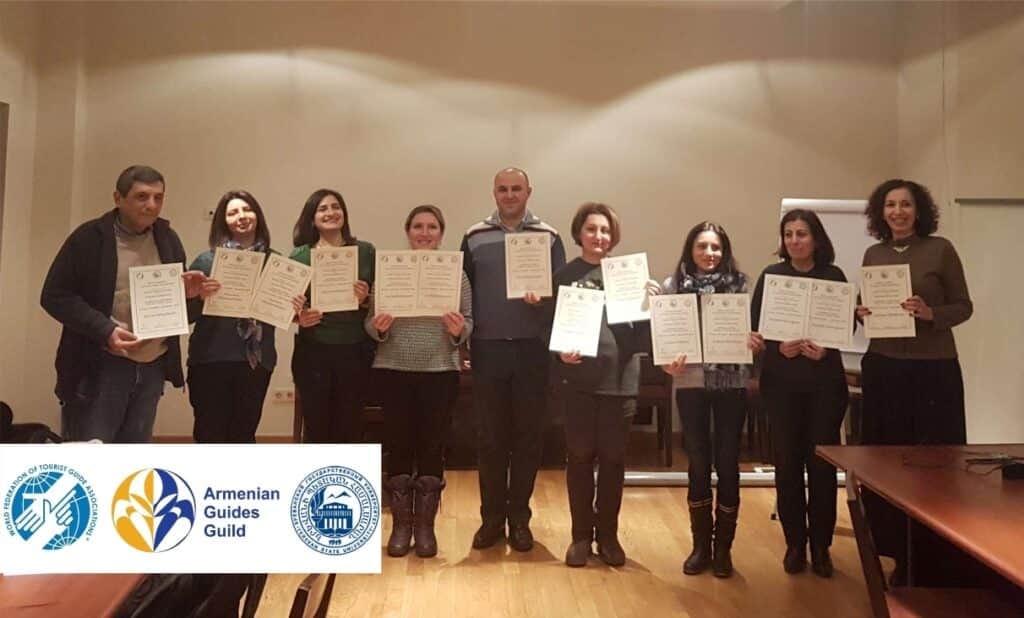
Since 1996, WFTGA has delivered courses for tourist guides and trainers worldwide, with associations, ministries, UN Tourism and UNESCO.
Hands-On Tourist Guide Training (HOT)
Practical skills course based on EN 15565: a Communication Seminar plus fieldwork and assessment on coach, on foot and on site.
Train the Trainer
Prepares experienced guides to plan, deliver and assess training in line with WFTGA and EN 15565 standards.
Short courses and seminars
Guiding skills, heritage interpretation, communication, safety, digital tools and customer care.
Continuous Professional Development
Further education for practising guides. Some associations recognise it towards local licence renewal.
All WFTGA trainers are qualified, practising tourist guides. For local knowledge and a legal licence, always train with your national or regional association first.
Regulation and licensing around the world
Based on WFTGA research, the profession worldwide falls into three broad categories.
Fully regulated
A protected profession: specific qualifications and a licence required by law, official registration, ministry supervision. For example Greece, Cyprus, Italy, Malta, Austria, Iceland.
Partially regulated
Guides may be licensed but formal state training is often missing. A degree or exam sometimes replaces dedicated guide training.
Unregulated
Anyone can guide: no legal requirement for training, exams or licences. Voluntary certification sometimes fills the gap.
Our role, across all three
- Promote regulation and recognition where none exists
- Raise standards where systems are partial or outdated
- Support training and accreditation for guides and trainers
- Advocate for policies that protect heritage, visitors and the profession
Accreditation and support
- Advice on curriculum design aligned with EN 15565
- Assistance with programme accreditation
- External examiners and quality review
- Support for CPD and CMD scheme development
Associations are invited to contact the WFTGA Secretariat with their enquiries.
Questions about training?
Our Head of Training is happy to help with questions about courses, standards and accreditation.

training@wftga.org
Start with the right course
From your first guiding skills to training other guides: find the WFTGA course that fits your stage.