Today, on the 81st anniversary of the liberation of Auschwitz-Birkenau, the world observes International Holocaust Remembrance Day. This year’s theme, “Holocaust Remembrance for Dignity and Human Rights,” reminds us that remembrance is not merely about the past – it is a commitment to the present and future.
As professional tourist guides, we stand at the intersection of history and humanity. Every day, we interpret the world’s heritage to visitors from across the globe. This responsibility becomes especially profound when we guide at sites connected to the Holocaust, genocide, and the darkest chapters of human history.
Our Shared Responsibility
The Holocaust did not begin with concentration camps. It began with words – with propaganda, defamation, the distortion of truth, and the systematic dehumanisation of fellow human beings. It was enabled by bystanders who remained silent, by professionals who followed orders without question, and by societies that allowed hatred to become normalised.
In response to these horrors, the international community established the Universal Declaration of Human Rights in 1948 – a commitment that “Never Again” would such atrocities be permitted. As tourist guides, we have a unique opportunity and responsibility to uphold these principles through our work.
A Moment of Growing Concern
We observe with deep concern the rising tide of populism, nationalism, and extremism across the globe. We witness alarming echoes of the past: the use of propaganda to distort reality, the defamation of minorities and vulnerable groups, the intimidation of those who speak truth, and the deliberate manipulation of history to serve political agendas.
As the generation of Holocaust survivors passes, their testimonies become entrusted to us – to those who listen, learn, and transmit their stories with accuracy and dignity. The responsibility to counter denial, distortion, and historical revisionism falls increasingly upon educators, cultural interpreters, and professional tourist guides.
The Role of Tourist Guides: More Than History
Guiding at sites of memory – what is sometimes called “Dark Tourism” – is not merely about presenting historical facts. It is about fostering reflection, building empathy, and encouraging visitors to connect the past to the present.
As our draft for the new WFTGA Code of Guiding Practice states: “Address complex or difficult subjects – such as colonial history, war, and social injustice – with sensitivity and clarity. Acknowledge past wrongdoing where relevant and ensure historical memory is treated with dignity.”
Our Code further reminds us that we must “respect human dignity and actively reject all forms of discrimination,” and that we should “facilitate inclusive experiences that challenge discrimination and promote equity.”
This is not political – it is professional. Upholding universal values such as human rights, democracy, and the rule of law is part of our ethical foundation as tourist guides.
A Call for Professional Courage
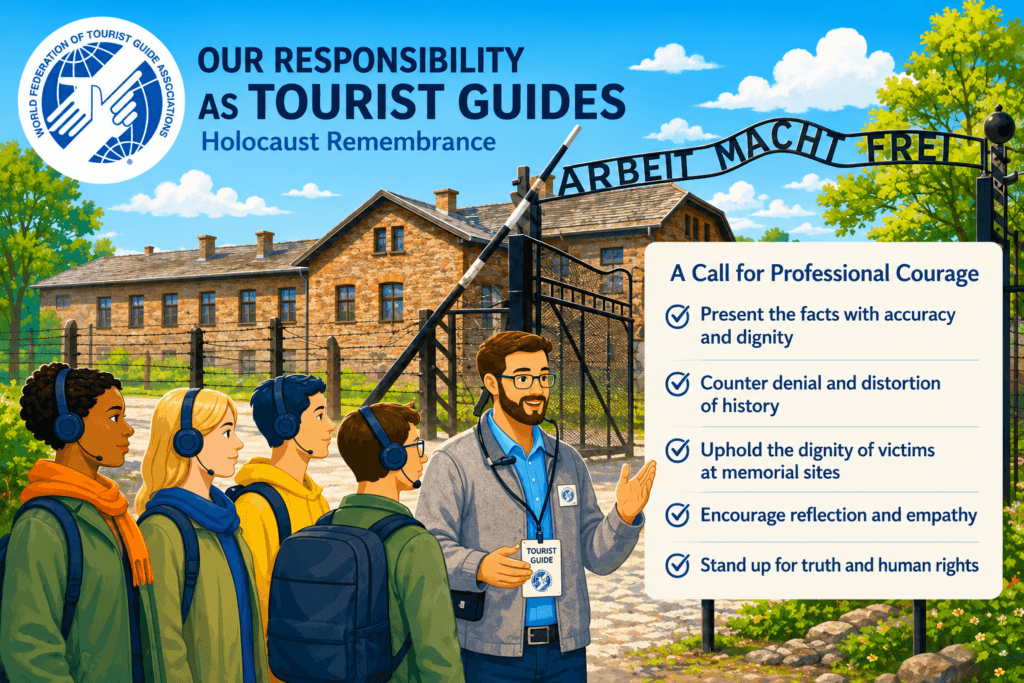
We call upon tourist guides worldwide to approach memorial sites not simply as locations to be shown, but as opportunities to educate, to inspire reflection, and to affirm our shared humanity. We encourage guides to:
- Present historical facts with accuracy, sensitivity, and dignity
- Counter denial and distortion with evidence-based interpretation
- Create space for visitors to reflect on the relevance of history to contemporary challenges
- Uphold the dignity of victims and respect the sacred nature of memorial sites
- Show professional courage in standing for truth, even when it is uncomfortable
Professional Development Opportunity
For guides seeking to deepen their skills in interpreting sensitive historical sites, we recommend the “Dark Tourism” seminar offered by the Federation of European Tourist Guide Associations (FEG). This programme focuses on the tourist guide’s responsibilities and sensitivities when interpreting history at sites associated with death and tragedy. The seminar examines different types of “dark” sites, discusses challenges involved in guiding such places, and explores sensitive approaches to interpretation.
Crucially, the seminar asks: does the tourist guide have a moral duty to influence opinions when visiting such sites? WFTGA believes that while we must maintain professional objectivity, we are not neutral on fundamental questions of human dignity and rights.
More information: www.feg-touristguides.com/dark-tourism.php
Never Again
On this International Holocaust Remembrance Day, the World Federation of Tourist Guide Associations honours the memory of the six million Jews and millions of others murdered during the Holocaust. We stand in solidarity with survivors, with their descendants, and with all who work to preserve memory and defend human dignity.
The words “Never Again” are not merely a memorial phrase – they are a professional commitment. Through accurate interpretation, ethical practice, and the courage to speak truth, tourist guides contribute daily to a world where such horrors cannot recur.
“Remembrance is not enough. We must transform memory into action:
through education, through truth, through the courage to speak up
when human dignity is threatened.” (Sebastian Frankenberger, WFTGA President)