A Day for the Working World — and for Those Who Guide It
On 1 May, the world marks Labour Day — a day dedicated to dignity, fairness, and respect in working life. It is a day on which we are reminded that every profession contributing to the functioning of our societies and economies deserves recognition, structured working conditions, and fair pay.
It is therefore the right moment for the World Federation of Tourist Guide Associations (WFTGA) to reaffirm a position that is still too often misunderstood — even within the tourism sector itself:
Tourist guiding is not a hobby. It is a profession.
Across the world, professional tourist guides perform skilled work that is experienced by millions of travellers every day — yet remains underestimated in its depth, its complexity, and its societal value. On a day that honours labour, we owe this profession the same recognition we extend to every other.
A Profession Between Expertise and Human Connection
Tourist guides operate at the intersection of knowledge, communication, and human interaction. Their work goes far beyond presenting facts.
They:
- interpret heritage with accuracy and depth,
- mediate between cultures in real time,
- create understanding where there was none,
- manage groups safely and respectfully, and
- shape how destinations are perceived and remembered for decades.
As expressed during the opening of the WFTGA Convention 2026 in Fukuoka:
“We are highly skilled professionals. We are storytellers, cultural mediators, conflict managers, psychologists, entertainers and educators — often all in one day.”
This multidimensional role demands more than passion. It demands structured competence, a strong professional identity, and the kind of continuous development we expect of every other knowledge profession — from teachers to translators to healthcare professionals.
The Reality of the Profession: Regulated, Partially Regulated — or Not at All
Globally, the tourist guide profession is far from uniform.
In some countries, it is fully regulated — requiring formal training, examinations, licensing, and official registration. Austria, Greece, Cyprus and many others demonstrate how structured systems ensure quality, safety, and professionalism.
In other regions, the profession is only partially regulated or entirely unregulated. In such contexts, individuals may operate without formal qualifications, training, or oversight — simply declaring themselves “guides”.
This lack of regulation creates significant risks:
- inconsistent quality standards,
- lack of verified knowledge,
- vulnerability of guests to misinformation, and
- erosion of fair working conditions for trained professionals.
The pattern is unambiguous:
Where standards exist, professionalism thrives. Where they do not, the profession — and the visitor experience — are at risk.
The Modern Pressures: New Threats to a Skilled Profession
On Labour Day, we cannot speak honestly about our profession without naming the pressures it faces today.
Platform-driven “free tours” advertise themselves as gifts to travellers, while in reality they rely on tip-based, often unregulated work. They undercut trained, certified guides and normalise the idea that this profession should not be paid like other skilled work.
Algorithmic platforms treat highly qualified human work as interchangeable inventory, using opaque ranking systems that decide whose livelihood thrives and whose collapses overnight.
AI-generated audio tours and chatbots are increasingly marketed as substitutes for the work of a trained tourist guide. They can deliver information. They cannot replace cultural mediation, ethical judgement, real-time group management, or the human encounter that defines our craft.
Precarious self-employment is the daily reality of most tourist guides — without paid sick leave, without parental leave protection in many systems, without unemployment insurance during off-seasons, and often without bargaining power against large operators.
These are labour issues. On Labour Day, they belong on the table.
Education: The Foundation of Professional Guiding
At the core of the profession lies structured education. Training is not optional — it is essential.
Comprehensive education programmes typically include:
- in-depth knowledge of history, culture, and heritage,
- guiding techniques and interpretation skills,
- communication and storytelling methods,
- group management and safety procedures,
- intercultural competence and conflict awareness,
- sustainability and responsible tourism practices,
- legal frameworks and ethical standards.
These elements reflect the principles set out in the WFTGA Code of Guiding Practice, which names professional identity, ethical responsibility, cultural sensitivity, and continuous learning as the foundation of the profession.
Professionalism is not a label. It is the result of education, practice, and commitment.
WFTGA Training: Building Global Standards
As the global federation, WFTGA actively contributes to strengthening education and training worldwide. Through its international training programmes, WFTGA supports destinations, institutions, and individual guides in building capacity and establishing professional standards.
A cornerstone of this work is the WFTGA Hands-On Tourist Guide Training (HOT – Guiding Skills) programme. This course represents the practical foundation of guiding. It focuses on the essential skills every tourist guide must master: communication, storytelling, group management, and professional conduct. The HOT programme is not an optional addition — it should be considered a fundamental starting point for every professional tourist guide.
It reflects a clear belief: quality guiding is learned, practised, and continuously refined.
Decent Work, Fair Pay, and the Sustainable Profession
Labour Day is, above all, a day for decent work — exactly the principle enshrined in the United Nations Sustainable Development Goal 8.
For tourist guides, decent work means:
- Fair pay that reflects skill, training, and responsibility — not the lowest bid on a platform.
- Predictable income models that recognise the seasonal nature of the profession instead of penalising it.
- Social protection that does not stop at national borders for guides who work internationally.
- A clear “no” to exploitative models such as unpaid work disguised as free tours.
- Equity and opportunity for women in guiding, and for under-represented voices in every region.
These conversations are not separate from training and standards. They are the labour side of the same coin: a profession can only be sustainable if it is respected, structured, and fairly supported.
Sustainability Begins with People
Sustainability is often discussed in environmental terms. For tourist guides, sustainability is also deeply human.
As stated during the WFTGA Convention 2026:
“Sustainability is not only about nature, climate or destinations. It is also about people. About how we work. How we cooperate. And very importantly: how we treat ourselves.”
Recognising tourist guiding as a profession is therefore not only an economic or educational issue. It is a foundational pillar of sustainable tourism.
A Call for Recognition and Action
On this Labour Day, WFTGA calls upon every actor in the tourism ecosystem to take concrete steps:
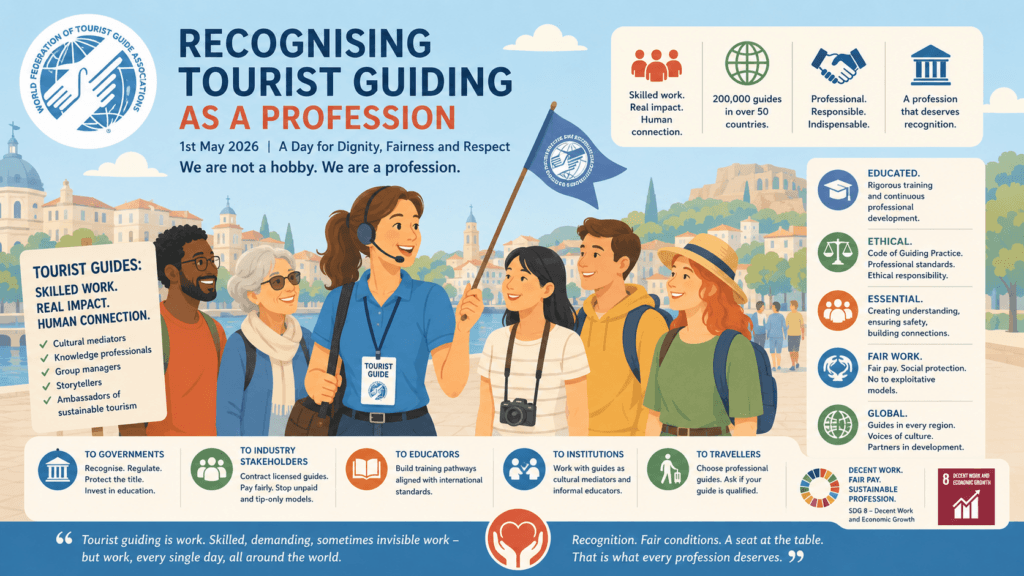
- To Governments and Tourism Authorities: Formally recognise tourist guiding as a regulated profession. Invest in structured education and licensing systems. Protect the title “tourist guide” in law, as Austria and several other states already do.
- To Tourism Industry Stakeholders — DMOs, tour operators, MICE companies, online platforms: Contract licensed, qualified tourist guides. Pay them fairly. Stop normalising unpaid or tip-only models that erode the profession.
- To Education Providers and Training Institutes: Cooperate with national tourist guide associations and WFTGA on training pathways aligned with international standards.
- To Cultural, Educational and Public Health Institutions: Recognise tourist guides as cultural mediators and informal educators — and partner with them on the ground.
- To Travellers: Choose licensed, professional tourist guides. Ask whether your guide is qualified. Your decision shapes the profession.
- To Our Own Profession: Remain organised. Stay in your association. Continue your professional development. Together, we are 200,000 tourist guides in over 50 countries — that is a voice the world cannot ignore when we speak together.
“Labour Day is the day on which the world remembers that work has dignity. Tourist guiding is work. Skilled, demanding, sometimes invisible work — but work, every single day, all around the world. We are not a hobby. We are a profession. And on the day that honours all professions, we ask only what we have always asked: recognition, fair conditions, and a seat at the table where the future of our work is decided.”Sebastian Frankenberger, President, World Federation of Tourist Guide Associations
The question on Labour Day is not whether tourist guiding is a profession. The question is whether the tourism world is ready to treat it as one.